Why Teachers Should Use Seating Charts Systematically to Support Classroom Management and Inclusion
February 2026 • 7 min read
Deciding who should sit where in the classroom may sound like a trivial matter. Maybe even just logistics. In reality, it is one of the most underrated tools teachers have.
An effective tool for classroom management
Research shows that teacher-directed student seating, in the form of seating charts, is one of the most effective classroom management tools available to teachers. When used well, seating charts can have a major impact on student behaviour, classroom calm, and the social environment in the class. Seat placement works by preventing disruption and shaping interaction before problems arise, reducing the need for reactions and sanctions afterwards. When it comes to classroom climate, seating charts can measurably increase the likelihood of new, mutual friendships — even in classes where students already know each other well. That is why it makes sense to treat seating charts as a deliberate, systematic, and professional classroom management strategy.
More calm, less disruptive behaviour
One of the most frequently cited studies on classroom seating comes from the Journal of Applied Behavior Analysis. In it, Bicard et al. (2012) compared teacher-directed seating with situations where students were allowed to choose their own seats. The results were striking, and probably no surprise to anyone who has spent time in a classroom: when the teacher controls seating, regardless of whether students are placed individually or in group arrangements, disruptive behaviour drops significantly. The study found as much as a threefold increase in disruption when students chose their own seats compared with the use of a seating chart.
It is also worth noting that the teacher in the study did not place students randomly; she took distractions, individual needs, and previous problematic combinations into account. That highlights an important point: the effect does not lie only in the fact that the teacher decides, but in the fact that placements are made on the basis of professional judgement and specific criteria. In other words, this is a fairly complex problem-solving task.
This insight is supported by a broader research review. Wannarka and Ruhl (2008) conclude that teacher-directed seating is generally associated with better classroom calm and more appropriate behaviour than so-called “free seating.” The effect is particularly clear when the teacher actively uses seating as a classroom management tool, not merely as a logistical necessity.
More new friendships and greater inclusion
When we talk about inclusion in schools, the focus is often on attitudes, rules, and community-building activities. Research on seating charts reminds us of a more basic mechanism that applies to all people: proximity creates relationships.
In a large randomized study published in PLOS ONE, Rohrer et al. (2021) examined how physical placement in the classroom affects social relationships. The results show that simply sitting next to one another significantly increases the relative likelihood of mutual friendship, with around a 50% higher relative probability that two students will develop a mutual friendship when they are placed as learning partners, or seatmates.
A strong classroom environment depends on students getting to know one another across existing patterns and groups. That makes it especially interesting that the effect does not only apply to “birds of a feather flock together.” The study shows that proximity also helps build bridges across established groups and across factors such as gender, ethnicity, and academic level (Rohrer et al., 2021).
In another study published in the Journal of Experimental Child Psychology, van den Berg and Cillessen (2015) analysed how seating charts influence students’ social status and relationships. They found that strategic placement can reduce social distance and affect who is perceived as popular or included. Faur and Laursen (2022) also found that changes in proximity related to classroom seating are linked to later friendship formation. Proximity affects who we talk to, who we work with, and over time, who we come to like.
Seating charts and student placement can also be used as a concrete, low-barrier intervention to influence relationships in a positive direction in cases of exclusion and bullying. In one study (Van den Berg et al., 2012) involving 651 fifth- and sixth-grade students, the distance between students who disliked one another was systematically reduced over several weeks by changing their seating. After the intervention, the results showed a reduction in student-reported bullying and exclusion, and the students who had been viewed most negatively at the start became better liked.
At the same time, research shows that seating must be used thoughtfully. It is not the case that simply “putting together students who do not get along” always leads to positive outcomes. The effect depends on duration, timing, and the support surrounding the intervention. This again underlines that seating charts should not be used randomly or as a spontaneous “shuffle” when something is not working, but as part of a deliberate and long-term strategy (Braun et al., 2020).
The most important — and most difficult — part: consistency over time
If we sum up the research findings, we see that effective use of seating charts reduces disruption, shapes relationships, and promotes inclusion — especially when the teacher’s professional judgement and priorities are respected, and when the work is carried out systematically over time. Individual seat changes can have an effect, but it is the systematic use of seating charts over time that truly shapes the classroom environment. Research on classroom organisation (Norsafiah et al., 2019) likewise points out that intentional organisation can lose its effect if it is not followed up systematically.
The challenge in practice is that traditional methods, such as pen and paper or Excel/Word templates, make it nearly impossible to keep track of history, variation, and relationship patterns over time. What starts as a good intention to work systematically is quickly replaced by pragmatic solutions in a busy school day.
Creating just one good seating chart can be challenging in itself, even if you set aside the ambition of working systematically over time. A desire for variation in learning partners must often, in addition to a range of individual needs and accommodations, be balanced against considerations related to the learning environment and classroom calm. Seating charts become a complex optimisation problem with many competing factors (Gremmen et al., 2016).
Digital tools make consistency possible
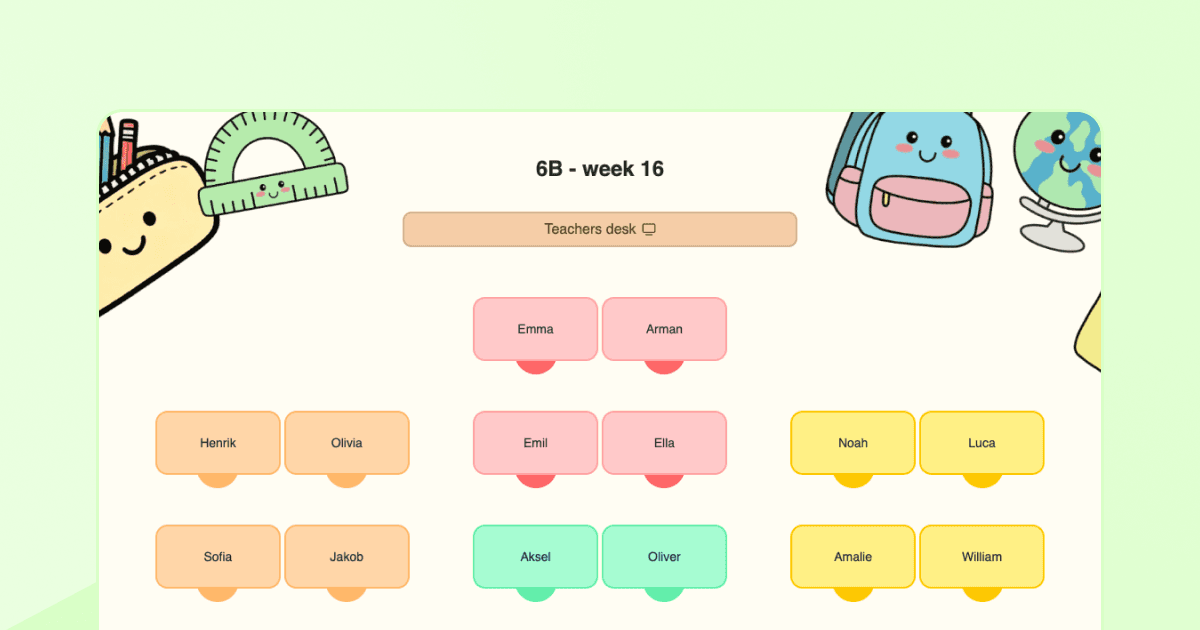
Because SeatSheet was developed by — and together with — teachers, we know which problems need solving. SeatSheet is designed precisely to support the teacher’s professional judgement, not replace it. The tool saves time, makes it possible to work systematically with varied learning partners, and provides valuable decision support through history and statistics. With specialised functionality such as automatic generation based on criteria like gender and who should or should not sit together, avoiding repeated learning-partner pairings, locking students to specific seats, and making easy manual adjustments through drag and drop, the friction is reduced significantly. What used to be a time-consuming puzzle becomes manageable. When seating charts are used in a planned and systematic way, they are no longer just logistics. They become a concrete tool for classroom management, inclusion, and relationship-building. A better classroom climate can be shaped intentionally. And with the right tools, that intention can actually be carried through in practice.